Monday, October 28, 2019

Danny Kaye's Stomping Grounds: Then & Now, Part II

econtinueing


His Catskills days behind him, Danny Kaye continued his slow climb up the ranks of show business primarily in New York. His biggest stops included:

(6) Where Danny Met Sylvia: 201 W. 52nd St., New York, NY
Two years his junior, Sylvia Fine grew up not far from Danny. She remembered having a crush on him as a young girl. For his part, Kaye did not seem to remember her, even though he briefly worked for her father, the neighborhood dentist. The first meeting they both recalled was in February 1939, in a loft-turned-makeshift theater on W. 52nd Street. Danny was rehearsing for a revue, Sunday Night Varieties, which was in need of another songwriter. Enter Sylvia.
They called the space the Keynote Theatre, and held performances on three consecutive Sundays. They were ready for a fourth performance, but were closed down when police discovered the facility didn’t have a proper license. The second-story “theater” has been used for a variety of purposes ever since. Today, it’s a for-rent event space called Manhattan Manor, which sits above Rosie Grady’s Saloon and looks out on Central Park.
Sunday Night Varieties, meanwhile, was able to move up in the world, to a better-furnished space inside the Barbizon-Plaza Hotel. The 38-story art deco hotel, at 106 Central Park South, was purchased by Donald Trump in 1981, who closed the hotel in 1985 to convert it into condos and rename it The Trump Parc. 
Through the doors and head up and, for a fleeting moment, you'd find a loft theater called the Keynote.

(7) Danny’s Broadway Debut: 219 W. 49th St., New York, NY

Kaye first appeared on a Broadway stage on Sept. 28, 1939, in The Straw Hat Revue. Comprised of sketches, songs and variety acts lifted from Danny and Sylvia’s last summer camp gig, the show ran for 75 performances at the Ambassador Theatre on 49th Street. 
The Ambassador had a unique set-up; because it was built in 1921 on an angled lot, it had to be situated diagonally, creating an extra-wide, none-too-deep auditorium, guaranteeing that even the worst seats in the house were close to the action. Many of its stately architectural features from the days of Danny remain intact, and its hulking chandelier is a reminder of the Straw Hat Revue’s Act One climax, “The Great Chandelier.” The theater has stayed active ever since, and since 2003 has been the home of Chicago. 
In the revue's show-stopping "The Great Chandelier," Danny played the Masked Gondolier.

Even the back of the balcony at the Ambassador offered audiences a close up look at young Danny Kaye.

(8) Danny’s First Solo: 57 W. 57th St., New York, NY

Kaye’s first break as a solo performer came in January 1940 when he agreed to a two-week tryout engagement at Dario’s La Martinique nightclub, inside the Medical Arts Building on W. 57th Street. Although the high-rise had 21 floors, La Martinique wasn’t on any of them—it was stashed in the basement, which had been used as a themed nightclub (first Parisian, then Cuban, and finally Latin American) since 1934.
At La Martinique, Danny performed Sylvia’s songs in a solo act for the first time, accompanied by Sylvia on piano.Over the years, the building—now simply called “57”—has housed a wide range of offices and businesses, including a few other nightclubs and a disco. 
Through the doors and head down to the basement was where you used to be able to find the La Martinique.

(9) Danny Goes Legit: 250 W. 52nd St., New York, NY

Kaye had only a small supporting role in Lady in the Dark, and one he kept for fewer than five months, but with it he nearly stole the show. It premiered at Broadway’s Alvin Theatre, which today operates as the Neil Simon Theatre. 
Danny in Lady in the Dark at Broadway's Alvin (now Neil Simon) Theatre.


(10) Danny’s Starring Role: 249 W. 45th St., New York, NY

Danny spent nearly a year and a half headlining the Cole Porter musical comedy Let’s Face It at the Imperial Theatre. The playhouse has premiered A-list productions ever since, including the original runs of Annie Get Your Gun (1946), Call Me Madam (1950), Oliver! (1963), Fiddler on the Roof (194), Cabaret (1967), Pippin (1972), Dreamgirls (1981), and of course Kaye’s return to Broadway, Two by Two (1970). 
Danny's two longest-running Broadway shows both played at the Imperial.

Next Time: In Part III, our travels will take us to more Danny Kaye landmarks outside of New York.

Tuesday, October 22, 2019

Danny Kaye's Stomping Grounds: Then & Now, Part I


Unfortunately, there aren’t many people around today who grew up knowing or working with Danny Kaye dating back to his early years in New York. But many places survive that we can visit to see where he began.


(1) Danny’s Boyhood Home: 361 Miller Ave., Brooklyn, NY

During his boyhood in the 1910s, Danny lived with his parents, two brothers, and grandmother in a small apartment on Miller Avenue in Brooklyn. Today, there’s a four-story building at that address, crammed with 20 tiny apartment units, but city records show that structure was built in 1925, after the Kaminskys had moved out. Perhaps the construction is why in the early 1920s, the family relocated to the next block, Bradford Street.


(Top) Danny about age 3 with an unidentified friend, possibly in front of his first home, at 361 Miller Ave. in Brooklyn. (Lower) Here's the site today. If building records are correct and this four-story apartment complex wasn't built until 1925, Danny and family moved shortly beforehand. 


(2) Danny’s Elementary School: 700 Sutter Ave., Brooklyn, NY

Danny was schooled through eighth grade at Public School 149, a five-minute walk from his family’s apartment. The facility, later renamed in his honor as PS 149 The Danny Kaye School, now teaches grades pre-K through fifth. (In 1952, Kaye recorded the school’s fight song, “Good Old 149,” as part of a medley with “I Belong to Glasgow” and “Tchaikovsky.”)


Danny's elementary school, PS 149, has been renamed in his honor.
Danny's home from adolescence through adulthood, at 350 Bradford St. in Brooklyn.


(3) Danny’s Longtime Home: 350 Bradford St., Brooklyn, NY
From the early 1920s through the late 1930s, Kaye listed his home address as 350 Bradford Street. The lease was in his father, Jacob Kaminsky’s, name. But since Danny was an itinerant show business performer, he “moved out” dozens of times, only to keep returning to Poppa until Danny married Sylvia Fine at age 29. The snug two-story brownstone, built in 1901, survives to this day.


Danny's home from adolescence through young adulthood, at 350 Bradford Street in Brooklyn, still stands.


(4) Danny’s High School: 400 Pennsylvania Ave., Brooklyn, NY

Thomas Jefferson High School was just a few years old when Danny enrolled. He dropped out shortly before graduation to pursue a show biz career. In 2007, the school was closed due to poor performance and the campus was given over to four smaller, specialized schools (performing arts/technology, nursing, civil rights, fire/life safety).


Danny's high school, Thomas Jefferson High School, is now four vocational schools in one.


(5) Danny’s Catskills Resort: White Roe Lake Rd., Livingston Manor, NY
In 1929 at age 18, Danny was hired as a “tummler” at the White Roe Lake House in the Catskill Mountains. Meyer Weiner had purchased the property in 1919 from Emory Keene, who had been operating it as a farm and boarding house. Weiner transformed it into a summer camp for young Jewish singles. Kaye was among the hired hands who made sure all the guests were constantly entertained, so they wouldn’t want to check out.
The main house offered lodging (with overflow guests and staff living out of tents), plus courts for tennis, basketball and handball, a baseball diamond, riding stables, boathouse, and private lake, three-quarters of a mile long, for swimming and boating. In all, Danny would spend six summers at White Roe, but brand new during his first was a gorgeous two-story Social Hall down by the lake. Topped by a gabled roof and faced with wood shingles and white trim, the elegant structure featured a recreation hall on the main floor, as well as an auditorium with a professionally equipped, 50-foot-wide stage. Every night it would come alive with dancing to a live orchestra or a stage production.
White Roe Lake continued as a Jewish singles resort through the 1950s. In the 1960s, the Weiners sold the property to the Hebrew Institute of Long Island, to use as a youth retreat called Camp HiLi International. The site was later purchased for a private residence, by a party who tore down all structures from Kaye’s days. Only a couple of reminders survive: an abandoned concrete pad where the tennis courts once sat and the entry road running the near-identical dogleg path that it always has, ending at the former site of that glorious Social Hall. In the exact spot sits a modern residence featuring a similar gabled roof.


White Roe Lake, Danny's first show biz home. The first real stage he ever appeared on was in the Social Hall (lower left).

Danny (back row, second from right), his arm around his mentor Nat Lichtman, with his 1935 castmates in front of White Roe's Social Hall.

All buildings have been torn down along White Roe Lake to make room for a private residence built on the site of the old Social Hall.


Next Time: In Part II, our travels will take us to five more historic Danny Kaye landmarks in New York
.


Wednesday, December 20, 2017

Working with Danny Kaye & UNICEF

Danny Kaye spent over 30 years tirelessly promoted the United Nations Children's Fund.

Danny Kaye’s work to benefit the United Nations International Children's Fund began in the early 1950s when he convinced Paramount Pictures to film him meeting with impoverished kids around the world, bringing them joy and medicine. The film, Assignment: Children (1954), would be shown in movie theaters and then patrons would be encouraged to donate.

Two years later, Danny headed out on a similar mission, this time taped by CBS for Edward R. Murrow’s See It Now TV show. Kaye would then spend the rest of his days touring the world and promoting UNICEF as its first Special Ambassador.

On June 1, 1983, when I interviewed UNICEF’s Horst Cerni for my book Danny Kaye: King of Jesters, Danny—despite failing health—had just been honored at a UNICEF benefit and was hoping to resume his travels after the summer.

(David Koenig) What is your position with UNICEF?

(Horst Cerni) Well, I’ve just taken over in the Special Events section. I used to be in Geneva. I just was in transit from Geneva to New York. So the person who did this before and who worked with Danny Kaye quite extensively is no longer with us, unfortunately.

(DK) How long have you been with UNICEF?

(Cerni) I’ve been with UNICEF since 1966.

(DK) Did you know Danny Kaye all this time?

(Cerni) No, I had worked with him once at the Expo in Montreal, in ’67, was it? And then I had seen him in Europe last year.

(DK) What kind of person did you find him?

(Cerni) Well, I think he is certainly a marvelous performer. And what I have seen him do in Europe as well as in Montreal was quite exciting, especially dealing with children who do not understand English. He’s a tremendous communicator.

(DK) You helped him set up in Montreal?

(Cerni) No, I don’t remember exactly what the situation was there, but it was at the UN Pavilion. And I think, like in the US, the 31st of October was declared UNICEF Day at the Expo and he was invited to be the honored guest of that.

(DK) How did Danny first become associated with UNICEF?

(Cerni) Yeah, it was quite a coincidence. He was traveling, I think, from London to New York on the same plane with the executive director of UNICEF at that time. So they started talking, and he became interested. He came over to the UN and he was invited to become our special envoy or special ambassador to talk about the needs of children and get acquainted with the situation of children—that’s how it really started. It was 1953, exactly 30 years ago.

(DK) Did anyone know he would work so well with children?

(Cerni) I think only on the basis of his performances, and I guess his appearances on TV as well as in movies, he was known to be a good comedian, with children especially, and I think that must have been the reason he got invited to work for us—to do something for us.

(DK) How were the tours set up?

(Cerni) Well, I don’t know how the first one was set up, since Paramount was behind it, and they filmed his tour. So that resulted in a major movie documentary, which was released even in theaters. And then another tour in the 1970s we filmed. But we arranged it so he got acquainted with various UNICEF-assisted activities, and usually it is in conjunction with information distribution and fund-raising concerns that our national committees organize.

(DK) Each tour requires tremendous planning?

(Cerni) Well, we haven’t had any major tours for some time. I mean he had gone to Europe last year and he will be going again this fall—as a matter of fact, we’re working right now to see if we can set up a trip for him, but that would depend to some extent on his health improvement. So we are not quite sure, but we have field offices most developing countries, and they are equipped to arrange the visit in the most essential way and to meet government people to possibly set up some appearances, not necessarily performances, but certainly appearances with children.

(DK) Was last year a long trip?

(Cerni) Well, only in Europe—and the United States, of course—but I mean the major trip was to the Netherlands (in 1981).

(DK) Did it consist of benefit shows?

(Cerni) There was a benefit football game, actually. It was a rather curious event in the sense that it was organized, I think, by executives playing against journalists. And it’s an annual event and he is very much loved in the Netherlands. They invited him to come to see if he could participate in this as a fund-raising event for UNICEF.

(DK) What was his part in the game?

(Cerni) Well, for example, at the opening ceremony, he joked around with the musicians, and then in the middle of the game all of a sudden he started blowing the whistle and he appeared as an ambulance attendant and he rushed on the field with the game in the way, and he got a red card from the referee and then he wheeled off one of the players, saying, “He is no good to play.” He put on a funny little show.

(DK) Is Assignment: Children still being shown?

(Cerni) It’s still being shown, but more as a reference. But it’s still apparently used in some schools and so on.

(DK) Do prints of See It Now exist?

(Cerni) We have a kinescope only because it was a television program.

(DK) Is it still shown?

(Cerni) Again, I think that’s more for reference, because it has never been distributed. It doesn’t belong to UNICEF. It was a CBS show.

(DK) Were language barriers a problem?

(Cerni) Well, no, it’s incredible. In most other countries, he meets people and personalities who speak English, but with children and the average person (in non-English speaking lands) he’s able to communicate just with signs and sounds and so on. And he has been quite amazing.

(DK) Is he still involved in the Trick or Treat campaigns?

(Cerni) Well, this is of course a regular feature in the United States every year and he has been very actively promoting it in various years. As a matter of fact, up until a couple of years ago, I think since the 1960s, he was flying (himself) across the country and stopping in over 20 different cities in one day. And he did something similar also in Canada.

(DK) Is it still going on?

(Cerni) Yeah, but he has not been promoting it directly. I mean I don’t know in the last year since I wasn’t (involved), so I really can’t say if he has been appearing at any particular function in connection with it. It’s possible.


Through the 1960s, Danny would fly himself to dozens of cities in a single day to promote UNICEF's Trick or Treat campaign.

(DK) What is the Trick or Treat campaign?

(Cerni) It’s simply that the children go from house to house, and instead of collecting candy, they go in an organized through their school or youth organization with a little collection box, and collect funds for UNICEF.

(DK) Is he still flying?

(Cerni) I don’t know.

(DK) Did he film a TV special for UNICEF in 1971 or 1972?

(Cerni) I’m not aware of it. I know we made a film after his visit to the refugee camps in Pakistan. That was in 1971.

(DK) Was it theatrically shown?

(Cerni) No, it’s just a documentary which we show at events or admission committees. It’s called The Pied Piper.

(DK) Tell me about the next trip in fall.

(Cerni) We are discussing a trip to Asia, but the exact details have not been worked out, depending on his health condition. So we have to wait and see a little bit.

(DK) Have you met Sylvia?


(Cerni) I was with her in Montreal and his daughter was there at the same time. I only met them at the World’s Fair. (He is usually accompanied) by just his manager, Herb Bonis. Obviously the best person to talk to is Herb Bonis, because he would have all the details.  At UNICEF, the people who have dealt with him in the past are not here now.

Friday, October 6, 2017

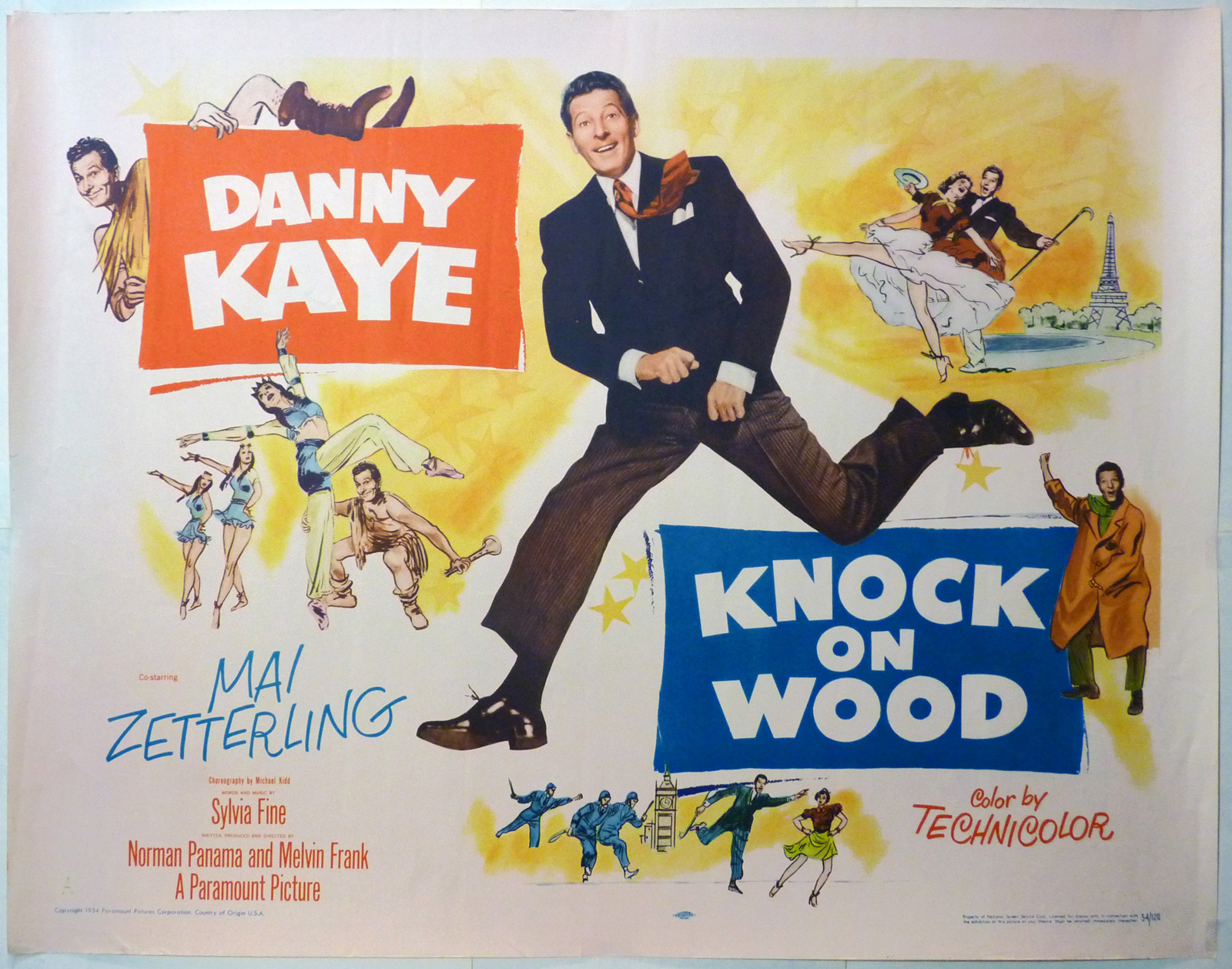
Memories of "Knock on Wood"

Danny Kaye left a wonderful impression on AD Francisco Day during the production of Knock on Wood.

Francisco “Chico” Day, the assistant director of Danny Kaye’s Knock on Wood (1954), was the first interview I conducted solely for my book—30 years in the making—Danny Kaye: King of Jesters. 

It was a Wednesday afternoon, February 3, 1982. I was a wide-eyed, 19-year-old college kid; Chico was 74 and had been in show business since the 1940s. He’d worked on over 60 movies, with Tracy, Hepburn, Brando, Elizabeth Taylor, Billy Wilder, and Cecil B. DeMille, for whom he helped pull off the parting of the Red Sea in The Ten Commandments. He got a lot of assignments, especially those shot in Mexico and Spain, because he was bilingual, and was the first Mexican-American to join the Directors Guild. But Chico struck me as a sweet, humble man who lived in a modest high-rise apartment in Los Angeles, and lit up with joy talking about working with Danny. (I checked in on him after the interview, and that year he sent me a Christmas card.)

Here’s our conversation:

[DK] You made a lot of films for Paramount.

[Day] Oh, yeah. I was about 25 years at Paramount.

[DK] Just Paramount? You were under contract to Paramount?

[Day] No, no. You know, we were employed at the time in the so-called “Golden Era,” you know? We weren’t under contract; we were hired on a yearly basis, but we weren’t under contract at all. We worked in many, many pictures over many, many years.

[DK] You were assigned to your films or you went door-to-door shopping?

[Day] Oh, yeah. They had the directors and the writers and the assistant directors and the production managers and the stars and everything. It was at that time, the so-called “Golden Era.” We really had stars. Now you pick up anybody on the street and he’ll be a star the next day. We used to groom them.

Anyway, Danny was a wonderful man. I loved working with him. But he always wanted me, whenever he had to do something, he wanted me to do it first. Like he had to climb a ladder in a theater, one of those backstage ladders way up onto the roof, and he didn’t want to do it until I did it. And when we were on the street and he had to run and then slide and then turn, he wanted me to go and do it for him.

So we had a great rapport with each other and I think that Danny was and still is one of the great mimics of the world. He’s a great musician, he knows music quite well, and comedy, and what else is there? I mean for a man who has attained as much popularity and position in the world as Danny.

I haven’t seen him since I made that (picture). We used to have a great set-up when he’d come into the stage, he’d always crawl out and say (in a heavy accent), “Cheee-co?” And I says, “Yes, Danny?” And he says, “Did you took a chave?” And I’d say, “Yeah, Danny.” And then he’d say, “You took a chit?”

And you know he was a great fellow to be around with and a great pro. He was always on time. There was no problem EVER with dialogue. If there was something that they were rehearsing and it didn’t work out the way that they thought it would work out, why just like that Danny would rehearse it once and that’s all. He had a real photographic mind and he would do anything that he had that we could do, because if the directors had something new for him, something that was better, Danny would take it always. But usually Danny was the one that would make suggestions, as far as I can remember.

[DK] He would improvise a little?

[Day] When it came to things that required music or anything like that I imagine that he and his wife would go over it, but he would improvise gags, whatever came up, whatever he was thinking about. He was just really one of the people I enjoyed working with and learning a lot of things from him becasuse he had a great personality and was very kind to people, very cordial.

Chico Day was an assistant director at Paramount for 25 years. He semi-retired in 1981 and passed away in 1995.

[DK] Was that the first time you met him?

[Day] Well, you know, I had seen Danny in the studio because I was at Paramount for many years, but that was the first time I worked with him.

[DK] There was (second-unit) filming in England, France and Switzerland. Did the whole crew go out there or was it just location shooting?

[Day] I don’t remember in Knock on Wood—it was all done on stage here at Paramount. We never went on location, but with other pictures, naturally. Patton, The Magnficent Seven: Mexico. Patton: Spain, England, India, Morocco, Crete. You took the whole crew. From here we took the nucleus crew and then we augmented it in Spain and then when we went to England and we had to use some of the English personnel. When you go to any other place that has the people involved, that are in the motion picture business, the theatrical business, they we’d use some of them. But usually we took our own crew.

[DK] Do you remember anything about the directors?

[Day] Panama and Frank? Oh, they were great. You know I never thought that two people could get along, but I think this was an exception. Originally they were writers together, and then when they decided to produce and direct, one of them would direct one picture and one of them would produce. Then they’d change around in the other picture. So it was very congenial as far as I was concerned. I know that later on when I left Paramount I think that they sort of broke up and decided to go their own way, but I wasn’t involved in any of that. I always thought they were very congenial and every once in a while, you know tempers would come up just like in any other human being and it was one of those things that was conveniently and defintiely settled and never, NEVER allowed a situation. They were really wonderful to work with.

[DK] So did just one of them direct the film?

[Day] Well, they were both on the set. But one of them was the one who took charge of that one particular picture. Like in Knock on Wood, let me see, I think it was, uh, Panama--was Panama the young one? You know it’s a funny thing. this was the only picture I did with them and naturally I didn’t think too much about it later on. But anyway they would change around. If they decided, like they decided that one of them was to be the director and that’s it. Interference as far as doing whatever he wanted to do, no, NEVER. The other one didn’t interfere at all. They would get behind the camera and discuss maybe one thing or another and whatever it was, why, if the director, the one that was directing, decided that what he was it, why that was done. There was no argument about it.

[DK] Was that for the whole picture?

[Day] Yep, yep.

[DK] Okay, in most musicals they tape the music before.

[Day] Well, musicals, I worked in several of them, in fact I worked on a lot of them; Hello, Dolly! was one of them, one of the later ones. But they pre-score the whole thing and then they have the playback and they play the music and then they have the singing and everything, whatever can be done. And the actor or actress just mouths it. But it’s so beautifully done, so well done, and we have person who is in charge of the music is on the set all the time and whenever they have music to do and he watches the mouhting very closely—his ear on the music and his eyes on the actor of actress to see that it is absolutely in sync. Then naturally the first time, the so-called “rushes,” the very next day we see the film and then everybody’s in the theater and they watch for all of these things to see if it does jive wth the music and so forth and so on. And that’s the way it is.

[DK] Do you know like Danny’s specialty songs, like he had one in Knock on Wood called “The Drastic, Livid Life of Monahan O’Han.” He was in a bar with some Irishmen and he starts to sing the song. There’s all these words and it’s really fast. Was that a plyaback on that?

[Day] Well, I’ll tell you what. I think that it was, but the other way is called a direct recording. I would imagine in a situation like that it might be done direct. We would sometimes use two cameras, so that if you got it perfect the first time, that was it. But at other times when there is a doubt, they do what is called a pick-up. They move the camera around and get a closer angle or whatever it is and then they start maybe a few bars back and then they pick up whenever the fault that occurred and they correct that with another take. It’s done different ways, but it’s usually the actor or actress feels whether they want to do it again or not. If they want to do a pick-up, why, they do a pick-up. If they want to do it all again, they’ll do it all again. It depends on how the individual feels at the time.

[DK] Sylvia Fine, Danny’s wife who wrote all those patter songs, did she hang around the set?

[Day] Well, Sylvia I don’t remember too much on the set. But Sylvia was there, I think, whenever Danny needed her or whenever she wanted to be there. Once in a while she would be on the set that I recall, and Danny would go over whatever it was they had to do and then she would watch and see that it was taken and done right. I have a remembrance that it was very few times that she ever came on the set.

[DK] Did you have any other stories?

[Day] Well, those things are so spontaneous, the things that happen, I don’t remember too much and it was so long ago. But my recollection of Danny as a person: very business-like, very attentive, cordial, a real gentleman. I never saw Danny really mad, though I’m sure that he must have. But when he came on the set he was just as joyful as he could be, always smiling and alert—my gosh, he was really a brilliant man. And I don’t ever remember him using his temper, you know though I guess he’s human, he could have. And he was always very polite with the other actors, very helpful. He would go and even if one of the actors had a problem, Danny would go ahead and rehearse with him, calm him down. That is if the actor wanted that type of—because actors are really very individual and some of them don’t want to have that particular feeling of the star wanting to help them.

There was this one individual that played the part of Brodnik. I don’t know if you remember the story(line), but Danny was to be met by Brodnik, and “Brodnik” would be the key word—that’s how Danny was supposed to know that this was the contact. And when we first rehearsed it, why it was really a wonderful situation because the fellow that played Brodnik would come by, Danny would get very close to him and he’d say (winking seductively), “Brrrrodnik.” Oh, You know, nobody could do anything like Danny did. He was always a great comedian. So, every once in a while I’d play that. I’d be Brodnik and I’d go up to Danny and I’d say (with an inviting wink), “Brrrodnik!”

The one thing I recall is having a good time. Always. From the time that Danny came on the set it was a pleasure. And then when the time came to take the scene, why then everything became very professional, very serious. But during the whole in-between, Danny was—if he wasn’t in his dressing room, if he wasn’t transacting business—he was talking to somebody and having a good time.

[DK] Had you ever worked with any of the people on the crew before or after, like Mai Zetterling?

[Day] I think that Mai, that was the first picture that she did. Now with Mai, we used to have a “Myer.” We used to say, “Hey, Myer!” to anybody and she used to think that it was “Mai.” That we were calling to her, see? And she would answer and pretty soon we just stopped using it because it disturbed her. Tobin Thatcher, I worked with him. Steven Giraut, I worked with him. He was Dr. Karl Krueger.

[DK] The technical people? Were you one big company or did you all get your jobs as you did and just ended up in the same film by chance?

[Day] It was a family. We worked the year round. So we’d go with maybe a completely different crew, but you know they were all people that were employed at Paramount, so we knew each other.

[DK] So you really liked your job?

[Day] Oh, my gosh, yes. There’s no job in the world that can compare to the motion picture business at that time. See, now a lot of lawyers have taken over and it’s a business. It’s a business that these lawyers should never be in, because it’s not a business of percentages. I mean that you feel that any one picture is like the other. It’s a business and that’s the way it should be treated. But it’s not so. It’s a creative business and they have no right in the motion picture business. However, you know, it doesn’t make any difference to me who it is that takes over. But the thing is that I don’t think that we’re making the type of pictures that we did when I was involved. Well, I’m still active, but the motion picture business has certainly changed considerably and a lot of the young people that are coming in are wonderful. They’re very talented, but they just don’t seem to have the creativity that the people of that era had. Maybe I’m not wise in saying that, but that’s the way I feel about it.

[DK] Maybe now they just think of it as a job?

[Day] No, I think what the trouble is, that the people that are coming into the business, they don’t want to start from the bottom. For instance, they go to UCLA or USC or any of the universities and they take a course in motion pictures, and when they come out they want to direct. Right off the bat. Well, if they can and if somebody’s willing to give them a chance, fine. But there are very few, very few that can do that. However, I’m not doubting that a lot of the young ones that are coming up have the talent, because that’s where talent comes from is youth. The only thing is that some of the old-timers can teach the young ones a lot of things to do. A lot of short cuts, a lot of ways of doing things. For instance, if you’re doing a stunt and the stunt works from a certain point to a certain point, a lot of directors would want to shoot the entire thing all over again from beginning. And other directors that are in the wise in this business and don’t want to take the time if so much of the take was good, they’ll change the angles on the camera and then do that portion coming into where the error was and then continue on. And so it’s a business where you have to know a lot of tricks and a lot of ways of remedying the situation.

[DK] Save time and money.

[Day] We did. I imagine that Knock on Wood probably was made for about $1 million in those days. A million two, a million three. Now you couldn’t make that for less than $10 million. So prices, living conditions, cost of living, and everything else goes up with it. Salaries are so tremendous now. I think that when we were doing that, in ‘53, I think the highest salary for first assistant director was $75 a week. Now, my gosh, a first assistant director, just a minimum, gets about $1,440 a week. Plus a lot of things.

[DK] So you’re a unit production manager now?

[Day] Yeah, well, I’m an assistant director or a unit prodution manager, either. Whatever comes up first. I’m working on seven projects right now, but I don’t know which one will materialize. Now for instance an assistant director that’s working on a weekly rate here in Hollywood effective as of July 1, 1982, he gets $1,445 a week—that’s for five days. Plus he gets a production fee of $63 a day! That’s something that I don’t even think counts as salary. It’s just a bonus. And on a distant location the production fee is $314 a week for first assistant director and the salary goes up to $2,024, and to think of getting $75 a week at that time and now getting over $2,000 a week. It’s quite a change.