
 |
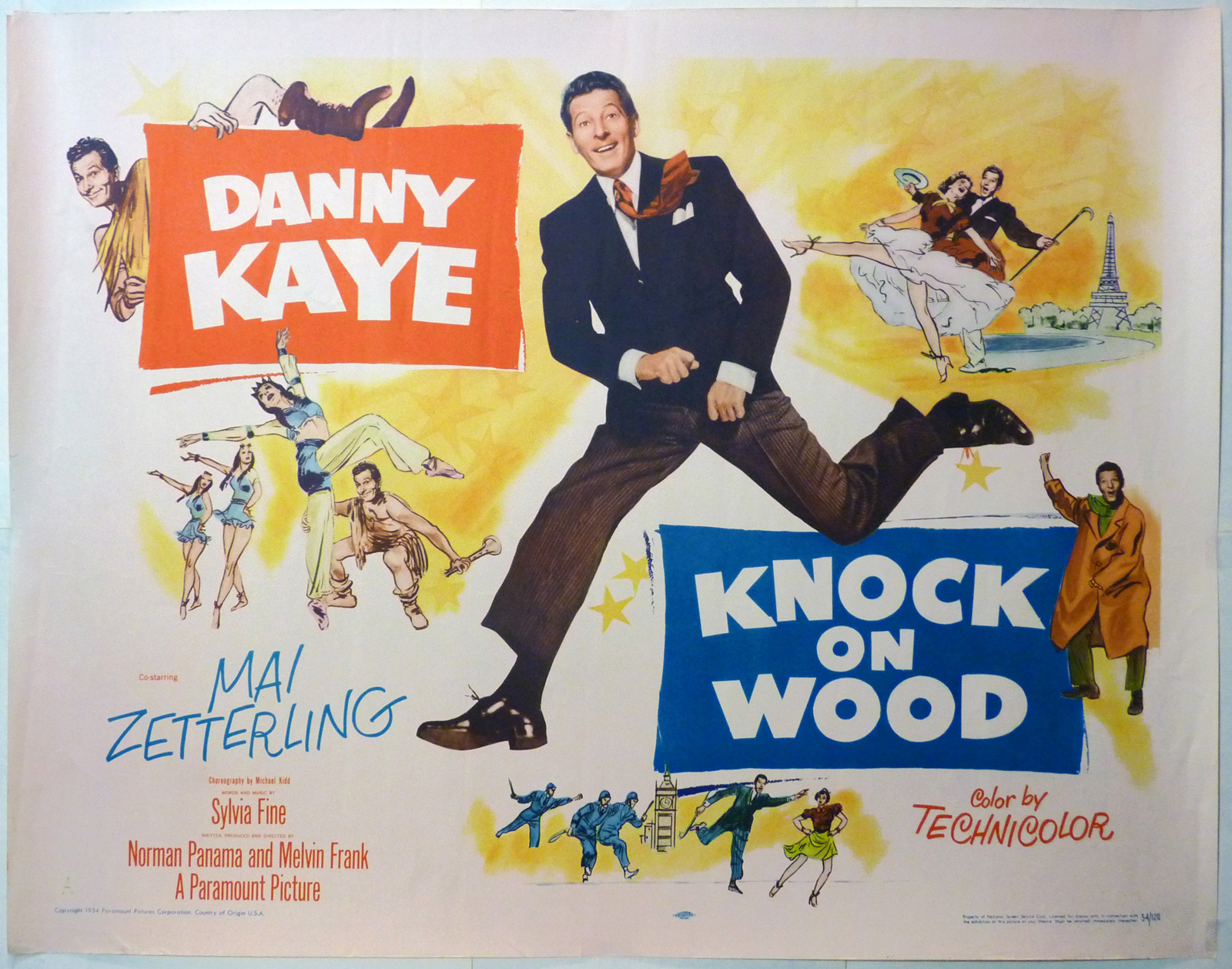
| Danny Kaye left a wonderful impression on AD Francisco Day during the production of Knock on Wood. |
Here’s our conversation:
[DK] You made a lot of films for Paramount.
[Day] Oh, yeah. I was about 25 years at Paramount.
[DK] Just Paramount? You were under contract to Paramount?
[Day] No, no. You know, we were employed at the time in the so-called “Golden Era,” you know? We weren’t under contract; we were hired on a yearly basis, but we weren’t under contract at all. We worked in many, many pictures over many, many years.
[DK] You were assigned to your films or you went door-to-door shopping?
[Day] Oh, yeah. They had the directors and the writers and the assistant directors and the production managers and the stars and everything. It was at that time, the so-called “Golden Era.” We really had stars. Now you pick up anybody on the street and he’ll be a star the next day. We used to groom them.
Anyway, Danny was a wonderful man. I loved working with him. But he always wanted me, whenever he had to do something, he wanted me to do it first. Like he had to climb a ladder in a theater, one of those backstage ladders way up onto the roof, and he didn’t want to do it until I did it. And when we were on the street and he had to run and then slide and then turn, he wanted me to go and do it for him.
So we had a great rapport with each other and I think that Danny was and still is one of the great mimics of the world. He’s a great musician, he knows music quite well, and comedy, and what else is there? I mean for a man who has attained as much popularity and position in the world as Danny.
I haven’t seen him since I made that (picture). We used to have a great set-up when he’d come into the stage, he’d always crawl out and say (in a heavy accent), “Cheee-co?” And I says, “Yes, Danny?” And he says, “Did you took a chave?” And I’d say, “Yeah, Danny.” And then he’d say, “You took a chit?”
And you know he was a great fellow to be around with and a great pro. He was always on time. There was no problem EVER with dialogue. If there was something that they were rehearsing and it didn’t work out the way that they thought it would work out, why just like that Danny would rehearse it once and that’s all. He had a real photographic mind and he would do anything that he had that we could do, because if the directors had something new for him, something that was better, Danny would take it always. But usually Danny was the one that would make suggestions, as far as I can remember.
[DK] He would improvise a little?
[Day] When it came to things that required music or anything like that I imagine that he and his wife would go over it, but he would improvise gags, whatever came up, whatever he was thinking about. He was just really one of the people I enjoyed working with and learning a lot of things from him becasuse he had a great personality and was very kind to people, very cordial.
 |
| Chico Day was an assistant director at Paramount for 25 years. He semi-retired in 1981 and passed away in 1995. |
[DK] Was that the first time you met him?
[Day] Well, you know, I had seen Danny in the studio because I was at Paramount for many years, but that was the first time I worked with him.
[DK] There was (second-unit) filming in England, France and Switzerland. Did the whole crew go out there or was it just location shooting?
[Day] I don’t remember in Knock on Wood—it was all done on stage here at Paramount. We never went on location, but with other pictures, naturally. Patton, The Magnficent Seven: Mexico. Patton: Spain, England, India, Morocco, Crete. You took the whole crew. From here we took the nucleus crew and then we augmented it in Spain and then when we went to England and we had to use some of the English personnel. When you go to any other place that has the people involved, that are in the motion picture business, the theatrical business, they we’d use some of them. But usually we took our own crew.
[DK] Do you remember anything about the directors?
[Day] Panama and Frank? Oh, they were great. You know I never thought that two people could get along, but I think this was an exception. Originally they were writers together, and then when they decided to produce and direct, one of them would direct one picture and one of them would produce. Then they’d change around in the other picture. So it was very congenial as far as I was concerned. I know that later on when I left Paramount I think that they sort of broke up and decided to go their own way, but I wasn’t involved in any of that. I always thought they were very congenial and every once in a while, you know tempers would come up just like in any other human being and it was one of those things that was conveniently and defintiely settled and never, NEVER allowed a situation. They were really wonderful to work with.
[DK] So did just one of them direct the film?
[Day] Well, they were both on the set. But one of them was the one who took charge of that one particular picture. Like in Knock on Wood, let me see, I think it was, uh, Panama--was Panama the young one? You know it’s a funny thing. this was the only picture I did with them and naturally I didn’t think too much about it later on. But anyway they would change around. If they decided, like they decided that one of them was to be the director and that’s it. Interference as far as doing whatever he wanted to do, no, NEVER. The other one didn’t interfere at all. They would get behind the camera and discuss maybe one thing or another and whatever it was, why, if the director, the one that was directing, decided that what he was it, why that was done. There was no argument about it.
[DK] Was that for the whole picture?
[Day] Yep, yep.
[DK] Okay, in most musicals they tape the music before.
[Day] Well, musicals, I worked in several of them, in fact I worked on a lot of them; Hello, Dolly! was one of them, one of the later ones. But they pre-score the whole thing and then they have the playback and they play the music and then they have the singing and everything, whatever can be done. And the actor or actress just mouths it. But it’s so beautifully done, so well done, and we have person who is in charge of the music is on the set all the time and whenever they have music to do and he watches the mouhting very closely—his ear on the music and his eyes on the actor of actress to see that it is absolutely in sync. Then naturally the first time, the so-called “rushes,” the very next day we see the film and then everybody’s in the theater and they watch for all of these things to see if it does jive wth the music and so forth and so on. And that’s the way it is.
[DK] Do you know like Danny’s specialty songs, like he had one in Knock on Wood called “The Drastic, Livid Life of Monahan O’Han.” He was in a bar with some Irishmen and he starts to sing the song. There’s all these words and it’s really fast. Was that a plyaback on that?
[Day] Well, I’ll tell you what. I think that it was, but the other way is called a direct recording. I would imagine in a situation like that it might be done direct. We would sometimes use two cameras, so that if you got it perfect the first time, that was it. But at other times when there is a doubt, they do what is called a pick-up. They move the camera around and get a closer angle or whatever it is and then they start maybe a few bars back and then they pick up whenever the fault that occurred and they correct that with another take. It’s done different ways, but it’s usually the actor or actress feels whether they want to do it again or not. If they want to do a pick-up, why, they do a pick-up. If they want to do it all again, they’ll do it all again. It depends on how the individual feels at the time.
[DK] Sylvia Fine, Danny’s wife who wrote all those patter songs, did she hang around the set?
[Day] Well, Sylvia I don’t remember too much on the set. But Sylvia was there, I think, whenever Danny needed her or whenever she wanted to be there. Once in a while she would be on the set that I recall, and Danny would go over whatever it was they had to do and then she would watch and see that it was taken and done right. I have a remembrance that it was very few times that she ever came on the set.
[DK] Did you have any other stories?
[Day] Well, those things are so spontaneous, the things that happen, I don’t remember too much and it was so long ago. But my recollection of Danny as a person: very business-like, very attentive, cordial, a real gentleman. I never saw Danny really mad, though I’m sure that he must have. But when he came on the set he was just as joyful as he could be, always smiling and alert—my gosh, he was really a brilliant man. And I don’t ever remember him using his temper, you know though I guess he’s human, he could have. And he was always very polite with the other actors, very helpful. He would go and even if one of the actors had a problem, Danny would go ahead and rehearse with him, calm him down. That is if the actor wanted that type of—because actors are really very individual and some of them don’t want to have that particular feeling of the star wanting to help them.
There was this one individual that played the part of Brodnik. I don’t know if you remember the story(line), but Danny was to be met by Brodnik, and “Brodnik” would be the key word—that’s how Danny was supposed to know that this was the contact. And when we first rehearsed it, why it was really a wonderful situation because the fellow that played Brodnik would come by, Danny would get very close to him and he’d say (winking seductively), “Brrrrodnik.” Oh, You know, nobody could do anything like Danny did. He was always a great comedian. So, every once in a while I’d play that. I’d be Brodnik and I’d go up to Danny and I’d say (with an inviting wink), “Brrrodnik!”
The one thing I recall is having a good time. Always. From the time that Danny came on the set it was a pleasure. And then when the time came to take the scene, why then everything became very professional, very serious. But during the whole in-between, Danny was—if he wasn’t in his dressing room, if he wasn’t transacting business—he was talking to somebody and having a good time.
[DK] Had you ever worked with any of the people on the crew before or after, like Mai Zetterling?
[Day] I think that Mai, that was the first picture that she did. Now with Mai, we used to have a “Myer.” We used to say, “Hey, Myer!” to anybody and she used to think that it was “Mai.” That we were calling to her, see? And she would answer and pretty soon we just stopped using it because it disturbed her. Tobin Thatcher, I worked with him. Steven Giraut, I worked with him. He was Dr. Karl Krueger.
[DK] The technical people? Were you one big company or did you all get your jobs as you did and just ended up in the same film by chance?
[Day] It was a family. We worked the year round. So we’d go with maybe a completely different crew, but you know they were all people that were employed at Paramount, so we knew each other.
[DK] So you really liked your job?
[Day] Oh, my gosh, yes. There’s no job in the world that can compare to the motion picture business at that time. See, now a lot of lawyers have taken over and it’s a business. It’s a business that these lawyers should never be in, because it’s not a business of percentages. I mean that you feel that any one picture is like the other. It’s a business and that’s the way it should be treated. But it’s not so. It’s a creative business and they have no right in the motion picture business. However, you know, it doesn’t make any difference to me who it is that takes over. But the thing is that I don’t think that we’re making the type of pictures that we did when I was involved. Well, I’m still active, but the motion picture business has certainly changed considerably and a lot of the young people that are coming in are wonderful. They’re very talented, but they just don’t seem to have the creativity that the people of that era had. Maybe I’m not wise in saying that, but that’s the way I feel about it.
[DK] Maybe now they just think of it as a job?
[Day] No, I think what the trouble is, that the people that are coming into the business, they don’t want to start from the bottom. For instance, they go to UCLA or USC or any of the universities and they take a course in motion pictures, and when they come out they want to direct. Right off the bat. Well, if they can and if somebody’s willing to give them a chance, fine. But there are very few, very few that can do that. However, I’m not doubting that a lot of the young ones that are coming up have the talent, because that’s where talent comes from is youth. The only thing is that some of the old-timers can teach the young ones a lot of things to do. A lot of short cuts, a lot of ways of doing things. For instance, if you’re doing a stunt and the stunt works from a certain point to a certain point, a lot of directors would want to shoot the entire thing all over again from beginning. And other directors that are in the wise in this business and don’t want to take the time if so much of the take was good, they’ll change the angles on the camera and then do that portion coming into where the error was and then continue on. And so it’s a business where you have to know a lot of tricks and a lot of ways of remedying the situation.
[DK] Save time and money.
[Day] We did. I imagine that Knock on Wood probably was made for about $1 million in those days. A million two, a million three. Now you couldn’t make that for less than $10 million. So prices, living conditions, cost of living, and everything else goes up with it. Salaries are so tremendous now. I think that when we were doing that, in ‘53, I think the highest salary for first assistant director was $75 a week. Now, my gosh, a first assistant director, just a minimum, gets about $1,440 a week. Plus a lot of things.
[DK] So you’re a unit production manager now?
[Day] Yeah, well, I’m an assistant director or a unit prodution manager, either. Whatever comes up first. I’m working on seven projects right now, but I don’t know which one will materialize. Now for instance an assistant director that’s working on a weekly rate here in Hollywood effective as of July 1, 1982, he gets $1,445 a week—that’s for five days. Plus he gets a production fee of $63 a day! That’s something that I don’t even think counts as salary. It’s just a bonus. And on a distant location the production fee is $314 a week for first assistant director and the salary goes up to $2,024, and to think of getting $75 a week at that time and now getting over $2,000 a week. It’s quite a change.


